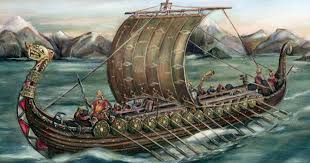
Who were the Vikings? The term “Viking” often brings to mind images of fierce warriors in longships, raiding coastal villages across Europe. While this image contains some truth, it only tells part of a much broader and more complex story.
Vikings were not a single people or nation, but rather a diverse group of seafaring communities from Scandinavia—modern-day Norway, Denmark, and Sweden—who lived during the period roughly between the late 8th and early 11th centuries, known as the Viking Age. The word “Viking” itself does not refer to an ethnicity, but to an activity. To “go Viking” meant to embark on overseas expeditions, which could include trading, exploring, or raiding. While some Vikings gained notoriety for violent attacks on monasteries and towns—such as the famous raid on Lindisfarne in 793—many others were traders, settlers, and explorers who established extensive networks across Europe, the Middle East, and even North America.
Viking society was complex and organized, with a strong emphasis on kinship, honor, and law. Contrary to popular belief, they were not simply chaotic warriors. They developed legal systems, known as “things,” where disputes were settled and decisions were made collectively. Their societies included farmers, craftsmen, merchants, and leaders known as jarls and kings. Women also held important roles, with some evidence suggesting they could own property, initiate divorce, and manage households in the absence of men.
One of the most remarkable aspects of Viking culture was their skill in shipbuilding and navigation. Their longships were fast, flexible, and capable of traveling both open seas and shallow rivers, allowing them to reach distant lands. This technological advantage enabled them to explore widely, from the British Isles and mainland Europe to Byzantium and the Abbasid Caliphate. Norse explorer Leif Erikson is even believed to have reached North America around the year 1000, centuries before Columbus.
Viking religion and worldview were rooted in Norse mythology, a rich system of beliefs involving gods such as Odin, Thor, and Freyja. These stories helped shape their understanding of the world, fate, and the afterlife. Over time, however, many Viking societies converted to Christianity, particularly as they settled in Christian lands and became integrated into European political systems.
Ultimately, the Vikings played a significant role in shaping medieval Europe. Their raids disrupted kingdoms, their trade routes connected distant regions, and their settlements led to cultural exchange and political change. Far from being merely destructive, the Vikings were also builders, explorers, and innovators whose legacy continues to capture the imagination today.